
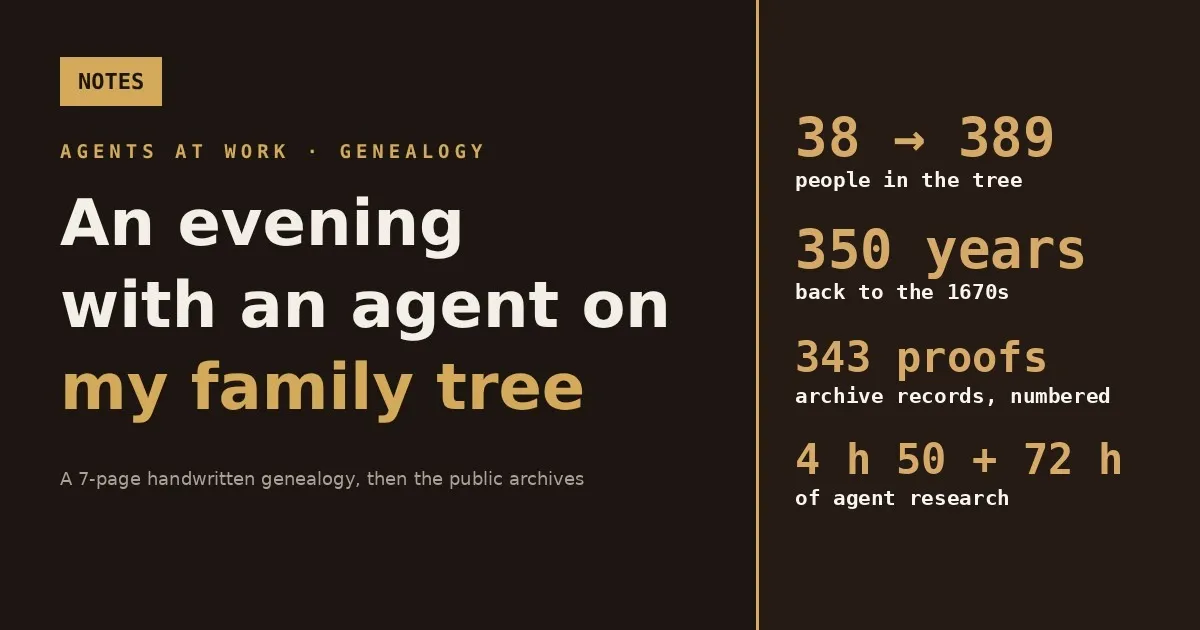
One Sunday evening in autumn I handed my family tree to an AI agent. It started as a tidy-up and became a research project in three stages: an evening that took the tree from about forty people to 137; three days in the public archives that took it to 389, back to the 1670s; and a discipline of proof that I had not planned and now would not give up. This is the path, with the figures, and no family names: the living deserve their privacy.
Stage one: an evening with the family papers
My tree on an online genealogy service was a skeleton: parents, grandparents, a few great-grandparents and many empty boxes. In a drawer lay a seven-page handwritten genealogy by my grandfather, with arrows and crossings-out, and a pile of scans: identity cards, death announcements in German, a veteran’s card, letters from a war graves commission.
I had the material but not the time to cross-check it. So I opened an agent that can drive my browser and read my files, and told it: here is my tree, bring it up to date. We moved in stages, and I validated or corrected at each one. It deciphered the manuscript page by page, linked people to records already on the service rather than creating new ones, read sixteen scanned documents and attached each to the right person. Just before midnight I exported the GEDCOM file, the standard exchange format for family trees; the agent reread it in full, merged sixteen duplicates and returned a clean file.
| Indicator | Before | After the first evening |
|---|---|---|
| People in the tree | ~38 | 137 |
| Direct ancestors identified | 18 | 51 |
| Generations traced | 6 | 8 |
| Documents attached | 0 | 26 |
It took about 4 h 50, scanning included. By hand, my own estimate is 18 to 24 hours.
Stage two: three days in the public archives
The evening used what the family already had. The next step was what the family never had: the registers themselves. French departmental archives publish their parish and civil registers online, free, page by page, as photographs of handwriting. Nobody indexes them for you. Reading them is the patient part of genealogy, and it is the part I handed over: about 72 more hours of agent research, working only from public registers.
The agent read baptisms, marriages and burials, decennial tables, a census, naturalisation decrees and military lists. It read French, the German of the registers kept between 1871 and 1918, when Lorraine was annexed, and Latin for the oldest acts. The tree now holds 389 people, and the earliest acts it rests on date from the 1670s: some 350 years, mostly of wine growers, ploughmen, shoemakers and village mayors, in a handful of villages a few kilometres apart.
Stage three: a proof for every link
What changed most was not the size of the tree but its standard of evidence, and this is where my day job came back. In service management a change without a record did not happen. Here the rule became: a link without a document is not a link.
- Every family link is marked established (the act was read, and it has a proof number), probable (concordant clues) or hypothesis (the same surname, nothing more). A shared surname is never treated as a link.
- Every proof is a capture of the register page, numbered, with the register’s reference and the image number, so anyone can open the same page. There are 343 of them.
- Nobody is invented. A person who is likely but unproven stays in a note, not in the tree.
- Suggestions copied from other people’s trees are not adopted until the act itself has been read.
- Searches that find nothing are written down too: which images were read, and which were not.
The discipline paid for itself. Two hypotheses the agent had put forward one day were refuted two days later by a marriage act: two men with the same name, a generation apart, had been taken for one. Refuted hypotheses were then removed from the tree and kept in the working document, with the reason. A birth date moved by three months; a death date turned out to have been copied from a brother; a surname had been misread; an index was wrong by six days. Small things, and each one would have been copied forward for ever.
It also tells me what I do not know. Some registers stop being online at a given year, a few years of the revolutionary period are missing, and several marriages are in no table. Those are listed as open, not papered over.
Italy: where no agent can go
Half of my family comes from northern Italy, and almost nothing there is online. The agent found which offices hold what, and drafted the requests in Italian; I attached my documents and pressed Send myself, to two town halls and a provincial state archive.
The archive answered first, with a copy of a military register sheet from the early 1900s: a call-up, and a discharge a week later for an insufficient chest measurement. It also taught me a lesson about sources. A translation of that sheet, supplied with it, gave a height more than twenty centimetres off the original. The agent caught it by reading the original. The two town halls have not answered yet, and four boxes in my direct ancestry stay empty until they do.
What the agent did, and what it refused to do
What it does well. Reading the unreadable, in three languages, for hours, without getting bored. Cross-checking: it flags a difference between two sources instead of overwriting one with the other.
The guard-rails it kept. No permanent deletion: it gave me the link and I clicked. Nothing sent in my name: letters were drafts until I sent them. No choice made for me where sources disagree: both versions are kept, with their source.
Its limits. It makes mistakes, and it produces hypotheses faster than anyone can check them by hand. That is why the proof numbers matter: they make the checking possible. And it cannot read what is not online.
What I take from it
I expected a tool that fills in boxes. I found a research assistant that reads my grandfather’s handwriting and says plainly when it does not know. The genealogist’s work is still mine: deciding, verifying, writing to town halls. It is the loop I use with coding agents, specify, verify, accept, in another field. If you want to try:
- Gather your sources first: scans, handwritten notes. The more material, the less it guesses.
- Set the rules at the outset: no deletion without you, no person without a source, nothing sent without your agreement.
- Ask for a proof number on every link, and for the list of what was searched and not found.
- Treat every hypothesis as open until an act closes it, and keep the refuted ones, with the reason.
- Export the GEDCOM regularly and have the whole file reread: that is where duplicates show.
- Protect the living: share the proofs of the dead, never the tree of the living.
Theme: Agents at work. Topics: Agents at work, Genealogy, Family history, Productivity.