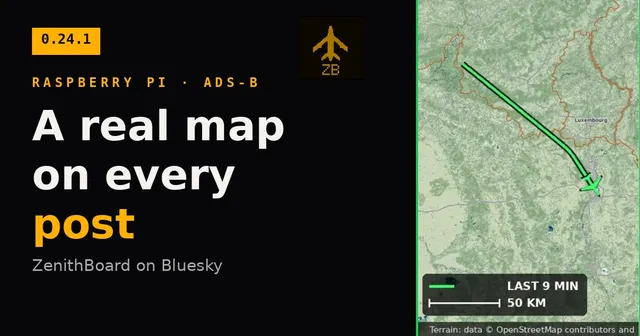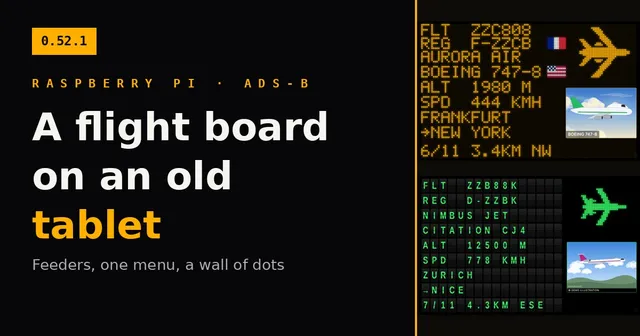

The third of three articles on what changed in ZenithBoard over one weekend (version 0.20 to 0.24.4). After the posts, every crossing and the real map, the third thing is the least visible one: ZenithBoard now counts what its wall could not name or draw.
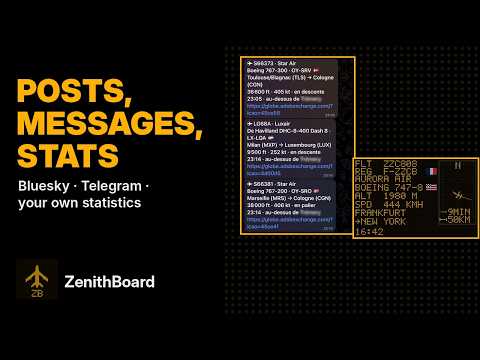
What ZenithBoard shares today, in video (the video of that weekend was retired with the project’s move to its own channel):
 YouTube videoWatch on YouTube
Two gaps on the wall
The wall shows an airline’s name and a silhouette that matches the aircraft’s type: airliner, business jet, turboprop, helicopter, light aircraft, military. Two things can go missing:
- The airline. The wall carries a list of about ninety airlines. For the others, it learns the name from the route lookup, once one of their flights has been looked up (version 0.17.0: the wall had been throwing away an airline name that the route service sends with every answer). A flight with no route and no name from the list shows its bare callsign.
- The shape. An aircraft type the wall has no drawing for gets the generic silhouette.
Two features were waiting on the roadmap: a lookup of airline names for bare callsigns, and more silhouettes. Which airlines first? Which types? I could guess. I would rather count. At work, a change request that cannot say how often the problem occurs goes back for figures; I saw no reason to treat my own differently.
What is counted
Since version 0.21.0, with statistics on, the 15-minute sample also asks the wall which aircraft are inside its radius and notes, once per aircraft over thirty days:
- the three-letter callsign prefix of each aircraft shown with a callsign but no airline name;
- the type code of each aircraft drawn with the generic silhouette.
zenithboard stats gaps prints both lists, most frequent first. Nothing leaves the Pi, and the files take a few kilobytes a day on the card.
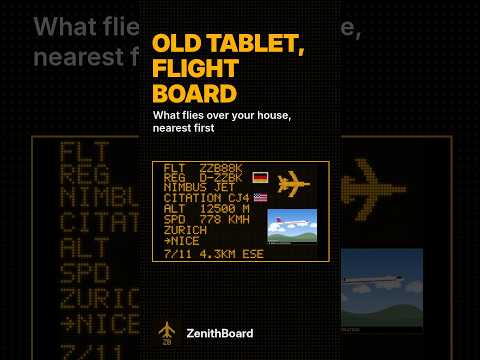
The wall in a 30-second Short:
 YouTube ShortWatch the Short on YouTube
The rule, written before the figures
The statistics were switched on on the Sunday of that weekend. I will read the figures after thirty days and, to keep myself honest, the procedure is written down in advance on the project’s roadmap, so that it does not depend on anyone’s memory or mood that day:
- an airline prefix seen on fewer than three aircraft in thirty days is noise. If no prefix passes that bar, the item is closed: the route lookup already names what matters. Otherwise, one lookup per prefix, asked once and kept for months, off by default, and checked against the real answers before it ships;
- the five to ten most frequent type codes get one shape each, and a shape is shipped only once I have seen it as a picture, which is the rule for everything on the wall;
- if the figures never come (the Pi was off, statistics were switched off), both items stay in the Later list. Nothing is built on a guess.
It is the same discipline as an acceptance criterion agreed before the work starts: the threshold is fixed while nobody knows which way the figures will fall.
One idea is already closed, in the roadmap’s table headed Not planned, and why: an offline database of routes by callsign. No free, complete and current one exists, and a stale route shown with confidence is worse than none. Saying no in writing saves answering the same question twice.
The same idea for the farthest aircraft
The statistics page had a number, 355 km, and no name. The decoder says how far the farthest aircraft was, never which one. Version 0.22.0 made the wall remember it, and the page now names it: the date and time, the airline and flight number, the route, the model and registration, the altitude, the distance and the nearest city of 100 000 inhabitants or more, from a list of 4 578 cities shipped with ZenithBoard, so nothing is asked of the internet.
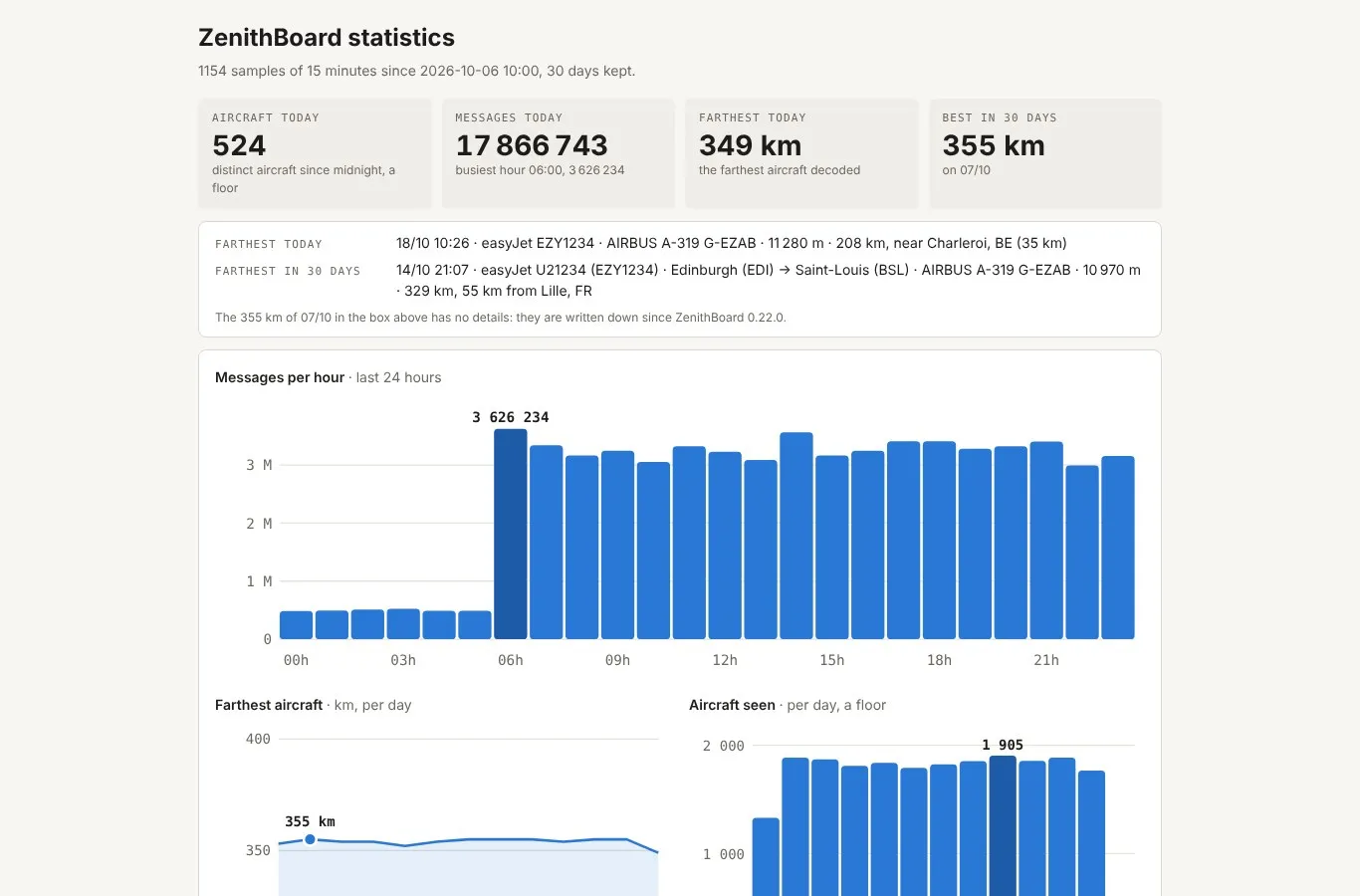
The page has grown a lot since that weekend. It now covers the last 24 hours, 7 days or 30 days, in the wall’s own look: the sky hour by hour, the airlines with their flags and the models most seen, the cargo airlines and business jets, the military aircraft by country, general aviation and how high they all fly. The weekly summaries on Bluesky are drawn from the same figures.
The first real farthest-aircraft line, on the Sunday, read 13:09 · TF-ICE · Boeing 737 MAX 8 · 322 km, with no airline and no route. At the edge of range the decoder often has an aircraft’s positions before it has heard its callsign. Version 0.24.0 fixed that: the wall remembers the callsigns heard in the last hour and fills the name in, before or after the farthest position. The record already written for that day stays as it is: the aircraft is long gone, and a record is not rewritten after the fact.
An honest note
The farthest-aircraft line was first tested against the real server with a made-up decoder. It sat on the Project status page in the column of things written and unit-tested rather than proven on hardware, and it moved to the other column when it had earned it: on 20 October the real page read easyJet EZY17QZ · Manchester → Verona · 335 km, near Cergy-Pontoise. The real sky then found one more thing to fix. The box above the line read the decoder’s farthest once a quarter hour, the line the wall’s own look every five seconds, and on one week the box said 183 nautical miles while the line named a Singapore Airlines A380 at 262. Since version 0.99.5 the box takes the larger of the two, so the two agree. That page is the one I would want from any supplier: not a list of features, but a list of which ones have been seen working, where, and what is still missing for the rest.
The same page keeps the known rough edges, the way a known-error list does at work: routes are looked up by callsign and a callsign can be reused for the other direction; the airline list covers ninety names; the feeders’ download addresses were copied from each provider’s page on one given day and providers move files. None of these is hidden in a closed issue.
This closes the series on that weekend: a flight board that posts by itself, a real map on every post, and these counters, read after thirty days. ZenithBoard lives at zenithboard.app, the code is on GitHub, and the Statistics page of the wiki has the details.
Theme: ZenithBoard. Topics: ZenithBoard, ADS-B, Raspberry Pi, Statistics.